Saturday, February 15, 2014

Entry - 2.15.14


I work near St. Peter’s Church at the Citicorp Center located in Midtown Manhattan and often look in on art shows that the church hosts in two spaces that are reserved for exhibitions.  The church’s stated mission is to offer “gallery space to artists whose lives and work explore the many dimensions of spirituality”…luckily a restriction that would not exclude the work of any artist that I can think of.  The gallery guidelines invite both established and emerging artists to submit proposals for exhibitions, which means that the quality of work found there can vary greatly.  I find this in no way a bad thing.  In fact, I think it’s terrific that a location in Midtown that gets a ton of foot traffic is available to unestablished artists.  There are times that I pass by the church, peer through the windows and am so unimpressed with the artwork on display that I walk on by, but occasionally I see a show there that I really enjoy.

In September of last year, I noticed from the street that the church was exhibiting some competent figurative work and made a mental note to myself that I should get over to the gallery to take a look.  About a week later, I made good on my intention, visiting the show on my lunch hour.  Immediately upon entering the gallery, I recognized that the work was far better than I had anticipated.  I quickly took in the room: the paintings were medium sized, the vast majority being figurative.  Compositions were original, pared down and cropped innovatively.  The paint handling was assured and organic, the artist’s brushwork more intuitive and spontaneous than my own.  Coloristically, the paintings worked for me, the artist successfully integrating saturated, artificial colors with more subdued flesh tones.  The artist had mastered perspective and anatomy.  Most of all I was impressed with how the artist painted flesh, probably the most difficult substance to depict with all of its subtle nuances, surface variations and tonal changes.  Occasionally, I noticed, here and there, a little flattening of form which I assumed resulted from working from photographs.  But, in general, the figures had weight, occupied space and were lit by a definable light source.  Additionally, the paint never got muddy, the darks staying active, the highlights pure and bright.

I was impressed.  I glanced up at the wall to see the artist’s name: Daryl Zang.  I was pretty sure from the subject matter that the artist was a woman (which, incidentally, is the case), and beyond that I didn’t need to know much more.  I think it’s always best to go into a show “cold”, and let the work speak for itself.

The first wall I approached was hung with a series of female nudes, which I found to be very competent.  I’ve discovered since then, as I suspected at the time, that these are self-portraits:
 
“I’ve been asked many times why I paint self-portraits.  The truth is that it kind of happened on its own.  I’ve always loved figurative drawing and painting and when I found myself home alone with a new baby I used myself as a model out of convenience.” – Zang


Zang - Sinking
 

Zang - Stripped
 

Zang - Drained
 

It’s not easy to suffer the scrutiny and commentary that a nude self-portrait initiates, and I commend Zang for her courage.  The works are very attractive, my favorite being Sinking, with its complex interlacing and overlapping of form.  This painting projects a more intense emotional state than is asserted in many of her other paintings, a contained anguish, that I found very moving.  But I suspect that Zang found this work, though quite successful, lacking in personal authenticity because it represents an artistic cul-de-sac, no other work in the show exploring similar emotional states.
 
The remaining works in the show addressed themes of motherhood, relaxation and pleasure.  As with the nudes, the vast majority of these works testified to a technical competence and exhibited a facile ability to devise innovative compositions.  There is no doubt when looking at these paintings that Zang is presenting specifically a female perspective.
 
“My work tells the story of my experiences as a woman, focusing on the moments that cause an internal shift in my thoughts or emotions.  At home as a new mother I painted about pregnancy and the early stages of motherhood, exposing all the uncertainty, isolation, and exhaustion as well as the tenderness.  When it was rest I craved, my work became about restful moments and quiet relaxation.  As my children grew older I found inspiration in the joy they discovered in each day and cherished our time together.  Now I can focus on how my own personality, opinions, and relationships have developed over the years.” - Zang
 
I think it’s wonderful that Zang is presenting images that explore the intimate moments in the day of a stay-at-home mother, especially considering how, in recent decades, the responsibility of child rearing has been disparaged and assigned to outside help.  Zang is inviting us to walk a mile in her shoes, to experience the private pleasures, the minor setbacks, the moments of exhaustion that define her day.  Strangely enough, for Zang, it was taking on the responsibility of caregiver that provided the impetus to focus on her painting.  For most artists, the distractions and interruptions that come with caring for babies and young children would become debilitating.
 
“My painting career truly came into focus after the birth of my first child.  Ironically, at this time, I found it unthinkable that I would have the time or energy to take painting seriously.  I found an escape in my studio and turned to self-portraiture in order to make sense of all the emotions that had arrived with this new phase of life.  I created imagery that was honest and infused with a female perspective which I found difficult to find elsewhere in art." - Zang
 
When successful, these works embody a candor and intimacy that is very moving.  In paintings such as Roots, New Beginning, Pause, All That Glitters, Second Reading, Cared For and Bliss, Zang excels, finding a balance between the personal and the universal, presenting images that are innovatively elemental and emotive.  In execution and subject matter, these paintings are reminiscent of the work of Janet Fish and Philip Pearlstein.
Zang - Roots
 

Zang - New Beginning
 

Zang - Pause
 

Zang - All That Glitters
 

Zang - Cared For
 
I would suggest that better judgment could have been exercised in naming some of the paintings.  I think Roots is too specific and strips the image of some of its mystery, while Drained and All That Glitters are cute and a bit precious.  In Bliss and Cared For Zang successfully tackles challenging subject matter: reflective surfaces, moving water and transparent mediums which distort imagery.
There are also a vast number of images that document the small pleasures that Zang indulges in during her day, pleasures that sustain and buoy her spirits: an afternoon nap, a good book, a cup of coffee, a hot bath, a glass of wine.
 

Zang - Centerpiece
 

Zang - Appreciation
 

Zang - Time Out
 

Zang - Cupcake
 

Zang - Indulgence
 
I guess this is all well and fine.  After all, Zang is telling a story of sorts, presenting a narrative constructed of moments in her day.  Most of these works are expertly executed.  I can’t help but admire the hand depicted in Appreciation or the glass of wine in Cupcake.  But as I was looking at many of these works, an uneasy feeling was welling up in me that the subject matter would be better suited for a facebook cellphone snapshot posting than serious art.  You know, “Tortellini al Forno at Olive Garden last night” or “Celebrated anniversary with bottle of Châteauneuf-du-Pape…Awesome!”  Of course, it could be said that my gender precludes my fully appreciating the subject matter, but I would be equally unreceptive to images painted by a male artist of the gung-ho gang gathered to watch the Sunday football game or documenting workout equipment at the local gym.  At the show, I found myself studying many of the paintings seeking within the agreeable imagery a greater depth, something more profound.
 

Zang - The Gift
 

Zang - Bliss


For instance, looking at The Gift, I wondered if the unusual cropping, the low perspective offering a generous glimpse of leg and thigh, the manner in which the frilly hem of the dress echoes the tissue paper packaging of the present suggest a slightly sinister interpretation involving a quid pro quo relationship.  Or when I look at Bliss, I can’t help but recall the long tradition of bubble imagery in art which goes back to the Renaissance, referencing the Latin expression, homo bulla, which translates roughly as “man the bubble” and serves as a metaphor for the transitory nature of human existence.(1)  In Bliss, is Zang bringing to our attention the brevity of pure happiness in our ever-changing lives and, taking this a step further, commenting on the fragility of life itself?  I’m not sure.
 
I hope this entry doesn’t read as too critical of Zang’s work.  From reading through passages on her site, I really got to like Zang.  She seems to be a great parent, a sincere chronicler of her creative process and motivations, a diligent artist struggling to produce high quality work.  Hopefully, if she were to read this entry, she would follow her own advice regarding criticism:
 
“As an artist’s circle of peers, galleries and collectors expands so does the noise of other’s suggestions and opinions.  You have to see through your own lens though.  This is true no matter what you do.  It takes strength to filter a lot of that away, but it is the only way to find your inner voice.  Only in believing in yourself does the true magic happen.” – Zang
 
I don’t believe that criticism is a bad thing.  I’m always pleased when my work elicits a strong response, good or bad.  My favorite comment I received when last I showed was: “Depressing, Almost evil, reflection of today’s world”.  Ultimately, the role of all art is to draw attention, to communicate, to move one’s audience to respond.  Zang should be pleased that her work motivated me to write this entry a full five months after seeing her show.  Her paintings testify to her technical abilities; it seems likely that, with continued dedication to her craft, Zang, who’s already exposing a rich and rarely explored perspective, will find themes and subject matter that more aptly convey the depth of emotion which her personal experiences inspire.  And, who knows, someday in the future, I might be wandering through the galleries of a major museum and come across a Zang hanging right along with Caravaggio’s The Foot Massage of St. Paul, Cassatt’s My Most Excellent Vibrator and Picasso’s Double Latte.
 
To see more of Zang’s work and read her own writings about art and process, please visit her site at: www.zangstudios,com.
 
All comments are welcome here.  If you prefer to comment privately, you can email me at: gerardwickham@gmail.com.
 
 
(1) Erika Langmuir, Imagining Childhood


Sunday, January 26, 2014

Entry - 1.26.14


When I moved north to the Hudson Valley, I experienced something that I had not before: continuous snow cover for months at a time.  In fact, commonly, snowfall is so regular and temperatures so consistently low that I’ve run out of places to deposit snow while shoveling the driveway, the banks eventually reaching chest height at the end of the season.  Rather than thinking them a curse, I relish these snow-filled winters.  As A child, I had always loved winter and the activities that came with it: sledding, skating, hiking, building snow forts and, of course, the traditional snowball fight.  On Long Island, you learned to savor the snow because, even though we had our major storms, the plows cleared the streets quickly and the temperatures moderated by the nearby ocean wouldn’t tolerate snow cover for more than a week or two at most.  So, once settled in our new home up north, I was pleased to find that snow was more than a transient visitor but a stalwart companion who demanded respect and attention.


Considering this introduction, you may be surprised to learn that, prior to my move north, I had never skied.  As a youth, the only skiing that would have interested me would have been downhill skiing, and Long Island was far too flat for that.  In high school, I remember some kids taking weekend bus trips to northern ski resorts, but financially that was out of my reach and I was a little too “unformed” to participate in organized social activities.  When I came to the Hudson Valley two decades ago, I noticed that a lot of people cross country skied and wondered if I would enjoy participating in this activity, a less exhilarating cousin of the downhill.


I wanted to give it a try but was reluctant to invest a lot of money in equipment, lest I discovered that skiing was not for me.  So I found myself one weekend at the local Ski Haus, explaining to a polite yet unenthusiastic salesman that I wanted to buy an affordable, bare-bones, off-the-shelf set of skis, just to get my toe into the water, so to speak.  He responded that it wasn’t that simple, that the skier’s height, weight and, obviously, shoe size had to be taken into consideration, and he began gathering data.  When he finished, the salesman crossed his arms on his chest, looked at me dubiously and announced that he would go into the backroom and see what they had in stock.  He vanished through a curtained doorway, and, for quite a while, I heard rattlings, crashes and smothered curses before he reappeared with a mismatched set of equipment pieced together from an assortment of clearance merchandise.  The salesman calculated the optimum pole length for someone of my height and cut the poles accordingly.  He rang up my purchase, and, though still more than I had intended on spending, the price seemed reasonable to me.  I paid and exited the store ready to begin skiing.

 
From the first time I went out, I knew that in cross country skiing I had discovered a fantastic activity that would provide me with pleasure for years to come.  Even though I was awkward as hell, stumbling regularly, meandering off track now and then and falling into the snow a couple of times on every outing, I loved the feeling of nearly effortless gliding and appreciated that I was getting a moderate aerobic workout too.  A little self-conscious at the beginning, I obsessed about getting out of the way of experienced skiers, choosing unpopular routes and stepping off track at the first sight of a companion.  I learned that, if I got out late and the temperature was too high, snow adhered to my skis, forming thick, hard clumps which made gliding impossible.  Additionally, I discovered that I was stressing muscles not commonly employed during normal activity.  So, initially, certain muscles, particularly the adductor group of the inner thighs, were crossbow taut and burned dully a few days after a weekend of skiing.  But I slowly improved, becoming more comfortable and confident on the skis, until I no longer considered myself a novice.


After about a decade and a half of experience, I am still using the same mismatched set of equipment and will get out skiing on any day I’m off from work when the conditions are right.  Commonly, I wake up before sunrise and, while still a little groggy, consider whether I want to go out today or not.  My bed is warm, and the house is cold, the thermostat having been turned low during the night hours.  There is a strong temptation to roll over and go back to sleep (after all, I’ve gotten up at 5:30 all week; I deserve it), but there is a voice within that reminds me that only through exertion can the exceptional be accomplished.  I reluctantly throw the blankets back, stumble out of bed and head for the bathroom for my morning’s ablutions.  I like to get out of the house by 7:00, though in recent years I don’t always make it out quite that early.  I load my equipment into the car, barely able to see in the pre-dawn light, and pick up my breakfast on the way to a nearby State Park at which the authorities permit skiing on their golf course during the winter months.  I eat in the car in the parking lot, while the light turns from slate gray to aqua and the windows cloud over from my breath and body heat.  I save my coffee for last, savoring every sip as I admire the winter landscape.  Believe it or not, I’m not always the first skier out in the morning; commonly there will be a car or two in the lot when I arrive.  Breakfast completed, I emerge from the car to find out what conditions will be like that day.  If I’ve made a good choice, the temperature should be well below freezing (but not bone chilling) and, even more importantly, the winds should not be too steady or intense.  I click into my skis (always a struggle), take my poles in hand and am off.


At the edge of the parking lot, I find a set of tracks, two parallel troughs in the snow, established by the passing of several previous skiers.  These tracks of snow packed down to a hard, smooth consistency will serve as guides for my skis, making steering and controlling the skis effortless.  The tracks lead me straight across the golf course, through an open, exposed area dotted with tall evergreens.  After five to ten minutes of skiing my muscles begin to tighten and ache, and I begin to wonder what I’m doing out here.  I know from experience that if I can keep it going, setting a reasonable, steady pace, that I can work through the pain, but, at the moment, this seems an impossibility.  The cold is intense.  Though I am wearing two pairs of socks, my feet, particularly the toes, are stinging with the cold.  My face is exposed, my lips becoming numb and my breath crystalizing in my moustache.  But worst of all are my hands.  Set in a fixed grip on my poles, they feel the cold most of all.  In fact, the pain is so intense that I recognize that if it continues to worsen I will have to capitulate and return to my car.  I promise myself that I will give it another five minutes before deciding what to do.


Just as I am ready to pack it in, the light changes, and I turn to the east to see the sun edging above the cluster of hills that ring the course, casting a golden light on the fairway.  The scenery is instantly infused with color: the snow glimmering with pinks and yellows, shadows transformed to pale cerulean.  I am stunned by with the unfathomable beauty that surrounds me.  At once, I can feel the warmth of the sun along the length of my body, and, though the pain in my extremities has not lessened, I continue skiing further out on the course, knowing that relief will be coming shortly.


From then on, I can focus more on my skiing, setting a pace that is challenging yet not exhausting.  My breathing becomes heavier, my heart rate picking up, but I’m careful not to push myself so hard that this activity becomes unpleasant.  Cross country skiing is, basically, pushing off of one ski and gliding on the other, alternating with every “step” as you would when walking.  When the snow is right and I’m in a good pattern, the gliding becomes protracted resulting in increased speed.  I stop for a moment to catch my breath and look behind me, surprised to find that I’ve crossed the last field in what seems just a few moments.  In the distance, I hear an incredible cacophony, the honking of an enormous flock of Canada Geese.  Sometimes their soundings seem ridiculous and comical, at other times, poignantly melancholy.  This morning it’s definitely the comical, a great chaotic hubbub that reminds me of the unruly crowds that I come across in New York City.  I continue to follow the tracks which lead me further out on the course, and, after another ten minutes, I surmount the crest of a sizeable hillock to see below me the geese, a surprisingly large gathering easily numbering in the hundreds.  The tracks leading right into the center of the group, I am a little concerned; I’ve had encounters with very aggressive geese in the past and worry that the whole flock will turn on me.  But I opt to stay on the tracks and proceed.  As I approach, the group remains calm and unconcerned.  Only a few birds on the periphery take note of me, become a bit agitated and waddle about, jockeying for more advantageous locations.  It’s only when I’m about 30 yards away that the whole flock seems aware of my presence.  At first, a handful of birds take flight, the vast majority apparently intending to hold their ground, and then, as if pre-orchestrated, the entire flock en masse takes to the sky.  For a moment, I feel enswarmed by the geese, their bodies eclipsing the sunlight, the beating of their wings strangely loud, and then they are gone, already passing over the distant woods, their honking already fading.  I stop on my skis and watch in wonder as they depart.


I continue on, reaching the furthest point from my car where a small wooden bridge spans a stream.  Ice encroaches on the stream from its banks, but, at its center, the black water still flows freely, a lazy mist hovering over its surface.  The reddish brambles that line the stream are encased in rime that blazes golden in the early morning light.  Once across the bridge, I veer to my left, choosing to hug the edge of the woods to maximize the distance covered on this outing.  The sun has swung well above the hills now, and I have warmed considerably, my hands and feet no longer in pain.  In fact, my core is so warm that I pop a few buttons on my jacket and pull my scarf away from my neck.  My muscles are loose, and I am in a rhythm, unconscious of any effort.  Every now and then, I come to a hill which is a struggle to climb, the grip of the skis not being secure enough to propel me upwards.  Instead, I anchor my right ski by turning it outwards, use the left to make progress uphill and then bring the right up from behind with a sort of a jerky hopping motion.  It’s slow going to the top, but I am rewarded with a long coast to the bottom of the hill, with me pushing with the poles to gain more speed and extend the ride.


I complete my circuit of the course in about an hour and a half.  When I return to my car, I see the parking lot now holds nearly two dozen vehicles, most of them lined neatly in a single row along the western edge of the lot.  As I clean the snow off my skis before loading them into the car, I watch some of the new arrivals preparing to get out on the course.  Their voices and laughter carry to me.  At this hour, the park which struck me as solemn and austere upon my arrival has been transformed by a merry bustle of activity.  Once I have loaded my equipment into the car and closed the hatchback, I stop a moment, hesitant to leave.  I am warm and comfortable in the morning coolness and am feeling that emotional rush that comes with exercise.  It’s odd how consistently this happens after these outings, but I experience an inexplicable sense of satisfaction, almost jubilation, that lingers for hours.


It occurred to me the last time I was on the course that skiing and painting have a lot in common…at least, for me.  I am often reluctant to go up to my studio.  I resent the isolation, the cutting off from the communal flow of the household, that painting imposes.  I often malinger about the house, enjoying a snack or engaging some poor soul in pointless conversation, in an attempt to delay the start of my efforts.  Eventually I recognize that I’ve wasted enough time and have to get to work.  This is a self-imposed discipline.  I have no deadline to meet, no audience awaiting with bated breath my next creation.  As with skiing, painting is a solitary pursuit, its rewards anchored in experience and health – in this case, mental health.  Once in my studio, I open the window, put a CD in the boombox and prepare my palette, squeezing out dabs of paint from the tubes in a horseshoe pattern and finishing by adding several sizeable globs of white in the center.  Finally, I mix up a potion of linseed oil, turpentine and varnish with which I thin my paints.  I stop at this point to assess my work, noting flaws and areas with which I’m dissatisfied.  I hesitate to begin, feeling like a novice, wondering if I really know how to paint.  At first I struggle, the process seeming arbitrary and artificial, as if I am simply applying paint to a canvas.  But then the image begins to assert its own logic and my labor becomes steady and purposeful.  Once in this mode, I become immersed in my work, my concentration becoming focused and absolute.  Time accelerates.  I am often shocked when a CD comes to an end, thinking I had just put it on five minutes ago.  It’s hard to explain the state that my mind is in.  It’s definitely engaged, tackling problems and assessing results, but it is also on cruise-control, a lot of processes “running in background” without conscious effort.  I feel very energized, at times almost ecstatic, and wonder why I was so hesitant to come up to my studio.  After several hours of work, I arrive at a point in my painting at which, technically, it seems prudent to stop.  As I clean my brushes, I become aware that the room is very cold and my back is aching from hunching over in my seat, leaning into the painting.  If it’s been a good day, as I stretch and twist before the painting, I admire my work, satisfied with my efforts, feeling an emotion somewhat akin to that which I described experiencing after a morning of skiing.  Afterwards, when I’m back among my family, it’s difficult to engage in conversation or focus on entertainment.  My mind, still addressing the painting, needs time to transition.


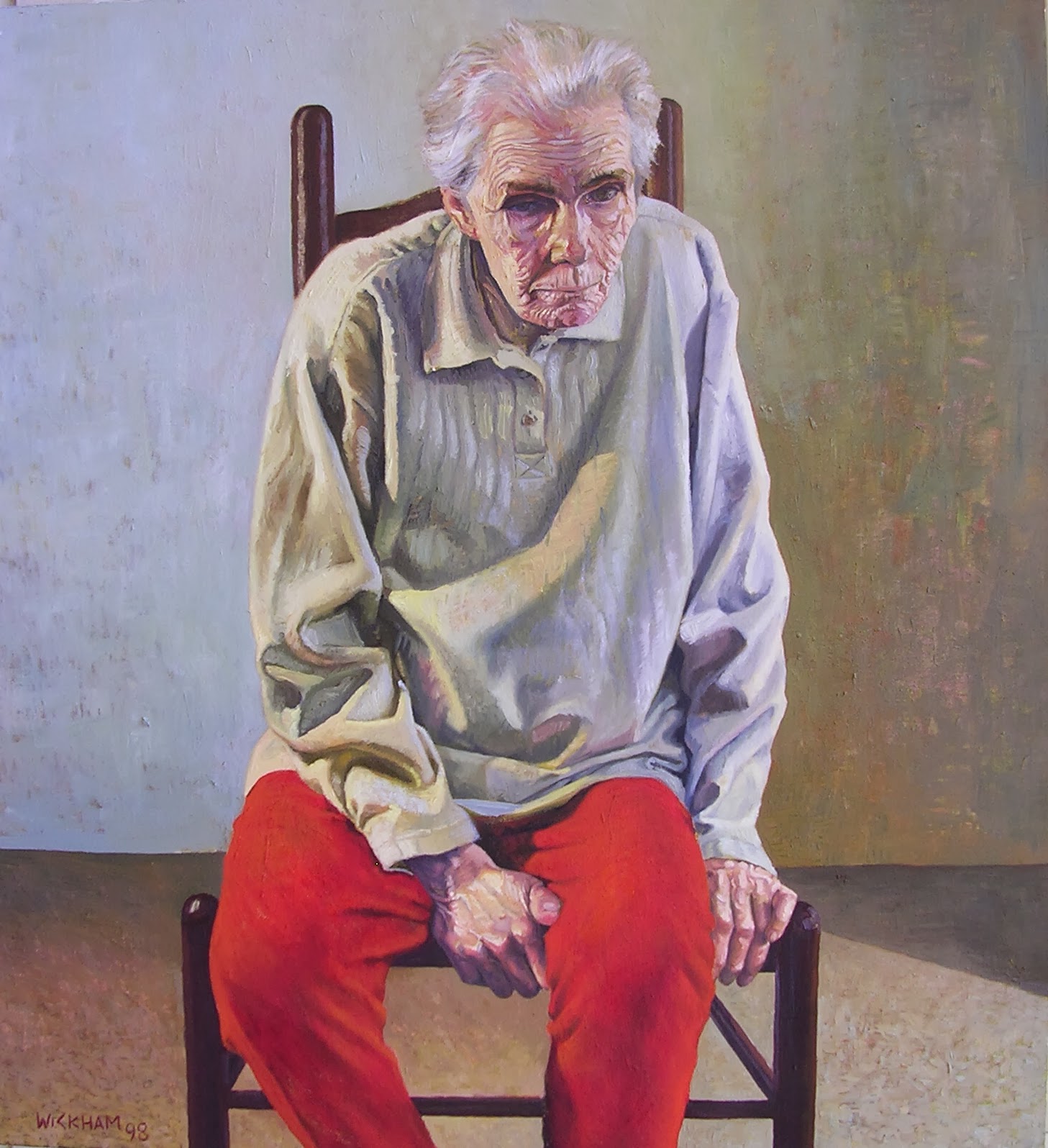
Wickham - Red Pants - 1998


Maybe because painting is critically important to me, I find parallels to the process in other activities I pursue.  If the season had been summer, I could easily imagine myself writing a very similar entry with hiking or bicycling as the topic.  On the other hand (just to prove that I haven’t lost all perspective), I’ve never been in the middle of a plumbing job or at the end of a day at the office and been inspired to ponder: Gadzooks!  This is a lot like painting!
 
Feel free to comment here.  If you would prefer to comment privately, you can email me at gerardwickham@gmail.com.


Monday, December 30, 2013

Entry - 12.30.13


In my last entry addressing the work of Antonio López-García, I observed how the “realist” label is haphazardly applied to artists with very diverse aims and techniques and questioned whether, at this time, the term has any meaning whatsoever.  I think the Modernist Revolution created an artificial gulf between those artists who depicted recognizable imagery and those who did not, with the result that many artists found themselves grouped into a camp with which they felt no particular philosophical allegiance.  That being said, I would feel comfortable applying the label “realist” to López-García.  In his work, he strives painstakingly to document the external semblance of his subjects, recording minute details during exhaustive sessions and taking measurements to ensure the accuracy of his observations.  As much as I greatly admire his work, I cannot help but raise the question of whether, by focusing on documenting a visual or physical reality, the artist has neglected to address the emotional facet of his subject matter.  Perhaps López-García would respond that it is the responsibility of the viewer to provide the emotional context to his paintings and sculpture, which I think would be a fair answer, but I, being ever of two minds, have to wonder if an artform which attempts to portray subjective, emotional responses to subject matter may more successfully capture the human condition.

 
In a previous entry, I wrote about my early interest in expressionism, an interest that continues to this day and, at times, became fairly obsessive.  For many years, I painted in my own “expressionist” style and explored woodcut and linocut printmaking techniques, modes of replicating images favored by the German Expressionists, particularly the “Die Brücke” group.

Wickham - John Matthews - 1983

I recognized that an immediate technique that emphasized critical features while minimizing superfluous detail, that permitted color to function as an expressive element untethered to visual reality, could serve as the perfect vehicle to capture the ephemeral nuances of human emotion.  I was fascinated by the expressionist work, in particular, the portraiture, of late nineteenth and early twentieth century artists like Edvard Munch, Ernst Ludwig Kirchner, Erich Heckel and Egon Schiele.  The visages of their subjects seemed more “real” to me than those depicted in art previously.  Their images mirrored the literature that I was interested in at that time, writing that unflinchingly dissected the motives and perspectives of complicated and flawed characters, work produced by such authors as Fyodor Dostoyevsky, Henrik Ibsen, Knut Hamsun, Anton Chekhov, Leo Tolstoy and Ivan Turgenev.


Munch - The Painter Paul Hermann and the Doctor Paul Contard - 1897


Heckel - Portrait of a Man - 1919


Kirchner - Sitzendes Madchen - 1910


So in a roundabout way I now arrive at the main subject of this entry: Chantal Joffe.  As is probably the case with most individuals interested in art, I enjoy combing through the vast arrays of images that result from random searches on the internet.  It’s a very democratic process that doesn’t favor established artists over amateurs.  For instance, a search for “Dutch self-portraits” could bring up a masterpiece by Rembrandt straddled by a work painted by a Haarlem art student and a cell phone selfie of a grandmother from Amsterdam.  The viewer will open a thumbnail if it impresses or intrigues him, usually without regard to its source.  Many times while doing this, I have been disappointed upon inspecting a full screen image of a thumbnail that caught my attention, but, on the other hand, I have come across many gems that I would probably never have discovered through any other means.  It was during one of my random searches that I happened upon the work of Chantal Joffe.

 
I was previously unfamiliar with the work of Chantal Joffe.  Even now, after doing a bit of research on her, I’m not sure what kind of a reputation she enjoys in the art world.  I do know that she received serious art training (BA in Fine Art from the Glasgow School of Art and MA from the Royal College of Art), has shown her work in many solo and group exhibits and has received a number of awards, the value of which I am ignorant.  Though born in Vermont (1969), Joffe is an English artist, currently residing in London.  She generally works from photographs gleaned from a number of sources: advertisements, family snapshots, fashion magazines and pornography, but I did find one interview in which she talks of working from the live model.  She prefers painting women, at times accompanied by children.  Her technique is loose and painterly, her energetic brushstrokes spanning the length of her sizeable canvases.
 

Joffe - Anna B -2012


Joffe - Brunette with a Bob - 2012


Joffe - Green Dress Black Knickers - 2009


Joffe - Kristen - 2010


Joffe - Megan - 2010


Joffe - Self Portrait with Esme - 2009
 

Joffe - Self Portrait (Year Unavailable)
 

Joffe - Topless in Purple Gloves - 2009
 

Joffe - Untitled - 2010


I was surprised to learn that the sources of her imagery are often commercial or salacious in nature because her paintings exude an intense aura of intimacy.  Of course, Joffe is not trying to replicate a photographic image.  She eliminates detail, paring down the information provided by her source material to a minimum, and hopefully, in the process, capturing the intangible essence that initially caught her attention.  She distorts, again partially out of that same sense of economy that permits her to generalize but also to intensify the viewer’s connection with her subject.  For instance, the ashen flesh tones in Self-Portrait with Esme remind us that this is an intimate scene, that these bodies, hers bloated and sagging, the child’s fragile and twisted, are not commonly on display, that under normal circumstances they would not see the light of day.  The exaggerated contrast between darks and lights emphasizes the fact that this image is derived from a poor quality snapshot taken with a flash, a personal family photo documenting a moment shared between an adult and a child.  Or in Megan, the atrophied and twisted legs sheathed in black tights lend an aura of vulnerability to the model.
 
When looking at Joffe’s work, we should have no doubt that we are witnessing the results of an artist imposing her imprint on a facet of reality.  Her canvases with their intuitive brushwork, energetic splatters and drips of paint and blatant distortions of form and color attest to this fact.  Through an illusive alchemy, she transforms banal subject matter into powerful images that thoroughly engage the viewer, suggesting that momentarily the veneer that shields the private from the public has been penetrated.  Without a doubt, Joffe is tapping into a deep emotional core when approaching these works and uses her source material merely as a framework on which to hang her very personal and subjective interpretations.  Her willingness to empathize with her models and assert her personal emotional response allows her work to document a subjective dimension of being, a critical component of any art that is purported to merit the label “realist”.
 
Let me know how you respond to Joffe’s work.  Am I seeing something that isn’t there?  Or do these paintings move you too?  Please comment here, or, if you prefer to comment privately, you can email me at gerardwickham@gmail.com.