Saturday, April 30, 2022

Entry - 4.30.22


“The painter should paint not only what he has in front of him, but also what he sees inside himself. If he sees nothing within, then he should stop painting what is in front of him.”                                                                                                                                - Caspar David Friedrich


Off and on over the last couple of months, I've been working my way through
The Complete Short Stories of Ernest Hemingway, a tome of 650 pages which includes writings roughly spanning the nineteen twenties through the fifties. I've been very impressed with the stories, in some ways finding them more satisfactory than the novels. The short stories embody an easy naturalism that at times eludes Hemingway in the longer works. I don't intend to provide a full review of Hemingway's fiction here but instead wish to focus on one aspect of his history which these stories exemplify: Hemingway totally embraced life, enthusiastically setting forth for wherever “the action” was happening, however distant or dangerous. He served in the Italian ambulance corps during World War I, rubbed elbows with Pablo Picasso, Gertrude Stein, James Joyce and Joan Mirรณ in Paris during the twenties, covered the Greco-Turkish War of 1922 as a journalist, documented bullfighting in Spain, big-game fished in the Caribbean, reported on the Spanish Civil War in the late thirties, actually led a small band of village militia in France during World War II and went on safaris in Africa. No matter where he went, he somehow seemed to obtain an almost miraculous understanding of local etiquette, practices and rituals. Apparently, he absorbed languages through sheer osmosis and could talk like a pro about corridas, weaponry, seamanship, food and drink and big game. I am literally in awe of the breadth of his knowledge and the vastness of his experience.


Ernest Hemingway

Perhaps my reaction to his exploits is a bit heightened since I am Hemingway's opposite. I am not well-traveled, having restricted all of my American expeditions solely to our nation's northeast and only venturing to Europe a handful of times. I don't rush toward “the action”; I try to avoid it. In fact, I was much chagrined to find myself in Berlin a month before the fall of the Iron Curtain in 1989, when refugees were already streaming from Eastern Europe into Germany. The situation didn't excite me but instead made me feel rather imperiled. I prefer serene predictability to volatile stimulation and believe, for me at least, that quiet contemplation without intruding distractions is essential to artistic creation. So, as you can imagine, I've led a pretty narrow existence.


I've only set up permanent residence in a couple of locations, all within the borders of New York State. Moving definitely has many benefits. You get to explore new locations and discover new restaurants, stores, art centers, music venues and parks. It can be pretty exciting. On the other hand, the experience of moving can be extremely trying, making mundane tasks challenging and routine activities demanding. I would say that moving means exchanging the familiar for the unfamiliar.


My wife and I, along with our two young children, moved to our current location in the Hudson Valley nearly 30 years ago, and I can still remember the experience as though it were yesterday. We were thrilled and relieved to be exchanging our confined and impractical quarters in Brooklyn for a large house situated on about two acres of land in a semi-bucolic setting. In fact, our furniture and possessions which had crammed our railroad flat in the city barely filled our new space, leaving our new accommodations feeling sparsely furnished and almost unpopulated. During the first months in our new digs, I recall retreating in the evenings with my three-year-old son to an upstairs bedroom to watch the sole TV station we could access with our telescoping antenna, a local station that usually hosted college basketball games. Seated on a span of pristine carpeting in front of a portable TV set (the only object occupying the room), we gratefully watched grainy images of young sportsmen fading in and out of focus as they vied for athletic supremacy. We ate our meals at a folding table set up in our dining room. We had only one car, which meant that my wife was completely stranded at the house while I was at work; for entertainment, she would bundle up the kids, load them into a double stroller and head down the hill to visit a fenced-in cow sedately munching on greenery at the curbside. We were so navigationally challenged that every journey we made for any purpose whatsoever always had the same destination: the one major thoroughfare in the area with which we were familiar. Years later, we laughed at our foolishness, how we often traveled miles out of our way to visit a store or restaurant that had an equally appealing alternative just minutes from our home. Honestly, I could go on forever.


Even after our exodus from Brooklyn, my life continued to be anchored in New York City. I still worked full-time in Manhattan, and my daily commute stole four full hours from my day. Sometimes I felt how ridiculous it was for me even to return to the Hudson Valley each evening. Once home, I would grab a quick bite to eat, watch a bit of TV with my wife and head off to bed early, hoping to get something close to the minimal number of hours of sleep needed to preserve life. I didn't learn much about our home's surrounding area. Our new property was a place to escape to and decompress after a stressful week of work. I didn't make connections with our neighbors; I interacted with quite enough people at my office and didn't need to add superfluous folk to the mix.


My wife is a very different kind of person, extremely social and approachable. And let's not forget that she was marooned along with two toddlers at our home unless I and the critically important car were there – certainly a powerful incentive to get the hell out of the house and press the flesh. So she quickly made connections with our neighbors and a handful of local groups and organizations. At that time, most of what I learned about our new environs was gleaned from her casual interactions with a diverse assortment of helpful and knowledgeable townies.


I honestly can't remember who it was that first apprised my wife of a nearby park that would be just the right place for our little ones, but whoever it was certainly did us a great service. Prior to this, we had a rather limited selection of locations where we could go to visit a playground and perhaps take a walk in the woods. Tymor Park was the perfect setting for our young family. Located close-by in a bordering town, the park consisted of a cluster of structures and amenities: a stately, old house, barns, long outbuildings, equestrian facilities, tennis courts, baseball and soccer fields, stables, silos, a playground and a well-maintained swimming pool. Most importantly for me, there was a reasonably graded, unpaved hiking path, about two miles long and girding a sizable pond, that could be traversed by small children. This hiking path, which included a few inclined sections providing a mild cardiovascular workout, passed by an old boathouse and observation deck, the ruins of an iron furnace and a man-made waterfall. For years, we took advantage of the playground and the path around Furnace Pond, without realizing that the park was actually much larger than we had believed it to be. We later discovered that, on the outskirts of the park, across some active roadways, are acres and acres of woodlands offering secluded and challenging hikes up and along a ridge of hills. In fact, encompassing over 500 acres, Tymor is the largest municipal park in New York State. We became aware of these additional holdings just as our boys were growing older and serious exertion became more inviting than swinging on a swing or shooting down a slide. In the right weather during certain seasons, the woods could assert a spooky aura which I, being an impish parent, would play upon to give the kids a thrill – hopefully not so intense as to keep them up at night or turn them off to hiking altogether. Generally, our travels were uneventful, lyrical and exhilarating. The trails in the deep woods are rarely used, and I've only come across a fellow hiker out there a handful of times in literally decades of visiting the park. These days, with the kids all grown, I hike alone and almost always opt for the secluded, outlying trails through the hilly backwoods. It's truly a joy to escape the frenetic demands of contemporary living and experience an hour or more of peace and isolation in a scenic, natural setting.


Mark Twain

Within just the last year, I learned that the park has an interesting history. This is going to get convoluted, so bear with me. In 1884, Samuel Clemens, known to most by his pen name Mark Twain, frustrated with his publisher, decided he would open his own publishing house and appointed his current agent, Charles Webster, as its director. Twain had reason to have every confidence in Webster. Beside serving as his agent, Webster had married Twain's niece, Annie Moffett, in 1875. Initially, Twain's publishing house was a success, but within less than a decade sales had fallen off precipitously. Webster, stressed-out and overworked, suffered a nervous breakdown, and Twain fired him. Sadly, Webster committed suicide in 1891. But during their marriage, Webster and Annie Moffett (who incidentally lived until 1950) had three children, and their only daughter, Jean, studied at Vassar College, traveled the world extensively, advocated for impoverished children and women's suffrage and became a successful and well-known author. In fact, one of Jean's books, Daddy Long Legs, was adapted into a popular play and later made into a movie which starred Fred Astaire and Leslie Caron. Jean eventually married Glenn Mckinney of Tymor Farms in Union Vale, Dutchess County. (“At last, a connection to Tymor Park!”, you exclaim.) Glenn and author Jean lived in marital bliss on the farm until Jean died after giving birth to a daughter at Manhattan's Sloan Hospital for Women in 1916. The child, also named Jean, survived and years later went on to marry Ralph Connor, the couple choosing to continue living at Tymor Farms. In 1971, Jean and Ralph donated the farm to the Town of Union Vale to be used as a public park. Six years later, the couple turned over to Vassar College 52 boxes of material that had been stored in barns and attics on the farm for decades. This material consisted of manuscripts, letters, notebooks, scrapbooks, journals, clippings and photographs gathered by several generations of family members who had lived at the farm and included among it was a large number of public and personal documents of Mark Twain, many of which scholars had no idea existed. I had been visiting this park for close to thirty years and had no knowledge of its history. I was particularly blown away to learn of its connection to Twain, a preeminent American author whose writings I had studied extensively while in college and continued to research after graduation. By the way, of Twain's four children, three died tragically before his own death, and his sole grandchild passed away without having any children of her own. This may explain how many of his belongings ended up in his niece's possession.

Tymor Plaque in Recognition of the Connors

During our nearly three decades of living in the Hudson Valley, we've learned of many amazing parks located quite close to our home. Each of them offers a few unique features such as challenging climbs, amazing views from great heights, extensive trails, scenic lakes and ponds, rushing waterways, roaring waterfalls, open fields, rock scrambling, historic buildings and ruins, fire towers, ice caves, flower gardens and abandoned orchards. I have visited many of these nearby parks multiple times and must observe that some of these features I've listed are not available at Tymor and those features that are available there are often exceeded by far in quality at other locations. For instance, the scenic views at Minnewaska Park or Schunemunk Mountain cannot be rivaled by those from the wooded hills of Tymor. The climb to the top of Bear Mountain is far more formidable than anything Tymor can offer. The deteriorating wooden structures at Tymor cannot compare with the mansions and gardens of the Roosevelt and Vanderbilt estates. All true. But Tymor offers probably one of the widest variety of these features among all our nearby parks and, for the most part, the quality of these features is of a truly praiseworthy character. I don't want to wax so poetic here as to lose all credibility, but I'm going to try to explain to some degree why I've formed such a strong attachment to this location. The park is pretty isolated, even the drive to it providing gorgeous views of open landscape, an ancient graveyard, rolling hills, horse farms and wooded avenues. It is nestled on all sides by ridges of hills that, depending on the time of day and the season, turn golden red or rust or grayish purple or deep green or cobalt blue. And being isolated, the park is not overrun with hordes of visitors. In fact, on most days my little Mitsubishi Mirage will share the large unpaved, dirt parking lot with only a few other cars. On the modern playground, you might find a couple of parents overseeing their children at play, but the trails are usually unoccupied. You're able to meander through this beautiful place free from distractions or interruption solely immersed in your private thoughts. Often the sound of trickling rivulets or rushing streams or crashing waterfalls accompanies your travels. There is a truly timeless quality to this park. While hiking you come across evidence of the endeavors of previous generations: century-old clapboard houses, farm structures, abandoned recreational facilities and the ruins of industrial works established in the early 1800's. Some of the hiking trails bear Native American names like Teaghpacksinck and Foghpacksinck. Would I be going too far to suggest that the park asserts to each visitor that he or she is part of a continuum, that their momentary experience of this place is not unique or individual but simply a facet of an endless communal connection with this land?


Many times while roving within the confines of this park, I am struck by the beauty of the scenery. Often the view of a wide expanse or even a seemingly insignificant detail will inspire within me a powerful emotional response. I can't explain this, but locations within this park frequently provide the quintessential, picture-postcard representation which defines for me the best of what each season affords. So, naturally, I've taken literally hundreds and hundreds of photographs at Tymor. Many of my photos document the same location, even the exact same perspective, but, for me at least, each is specific, asserting a unique character and mood. I will provide here a small selection of the vast number of photographs I've taken at this park over the years. Some of these pictures are actually scanned images from early film prints, so the quality of this selection may vary some.




We've even twice used the park as a backdrop for our annual Christmas card photo.


It occurred to me recently that I've probably painted the scenery at Tymor more often than at any other location. I don't commonly paint landscapes. It's not that I disparage the genre. In truth, I find the landscapes of Caspar David Friedrich, Ferdinand Hodler, Vincent van Gogh, Fairfield Porter, Richard Diebenkorn, Andrew Wyeth and Anselm Kiefer (to name just a few) to be truly stirring and effectively expressive of a distinct emotional state. But I struggle with landscape. For me, it's a matter of focus. In painting a landscape, I have trouble determining where to direct my energies and end up with an overall unsatisfactory execution. I think I get impatient and lazy. The figure remains for me my most natural instrument of expression. But I do paint scenes from nature now and then, especially while on vacation at a particularly impressive locale. And since retiring, I now have more frequent opportunities to explore local parks and trails, which regularly spark an interest in documenting a scenic vista. All the same, I still very rarely tackle a landscape and even more rarely will I approach a landscape as a weighty, laborious effort. I would define most of my landscapes as “studies”. This is why I was surprised to recognize recently that several of my major works have been inspired by the scenery at Tymor.


In 2003, I created View from Tymor, a large oil painting executed on canvas, which documents a view from an elevation overseeing roadways crisscrossing the park, bordering trees, scattered structures and distant fields and hills. I thought of this work as an abstract “symphony” composed of various movements whose details could be reorganized, emphasized and distorted in acquiescence to the whole.


Gerard Wickham, View from Tymor, Oil on Canvas, 2003, 46" X 52"

The following year, I painted on a wood panel Furnace Pond, Tymor Park. There used to be a deck above Furnace Pond at which my wife and I would occasionally set out on a picnic table a huge spread of cheeses, meats and other delicacies for our children to enjoy while we shared a bottle of white wine. I was decidedly interested in how the bright spring sunshine would wash out the tonalities of the distant pond, fields and hills leaving only the deck and the curtain of trees immediately behind it richly colored and in focus. It was an effect that definitely struck an emotional chord within me, and I set out to capture it in paints.
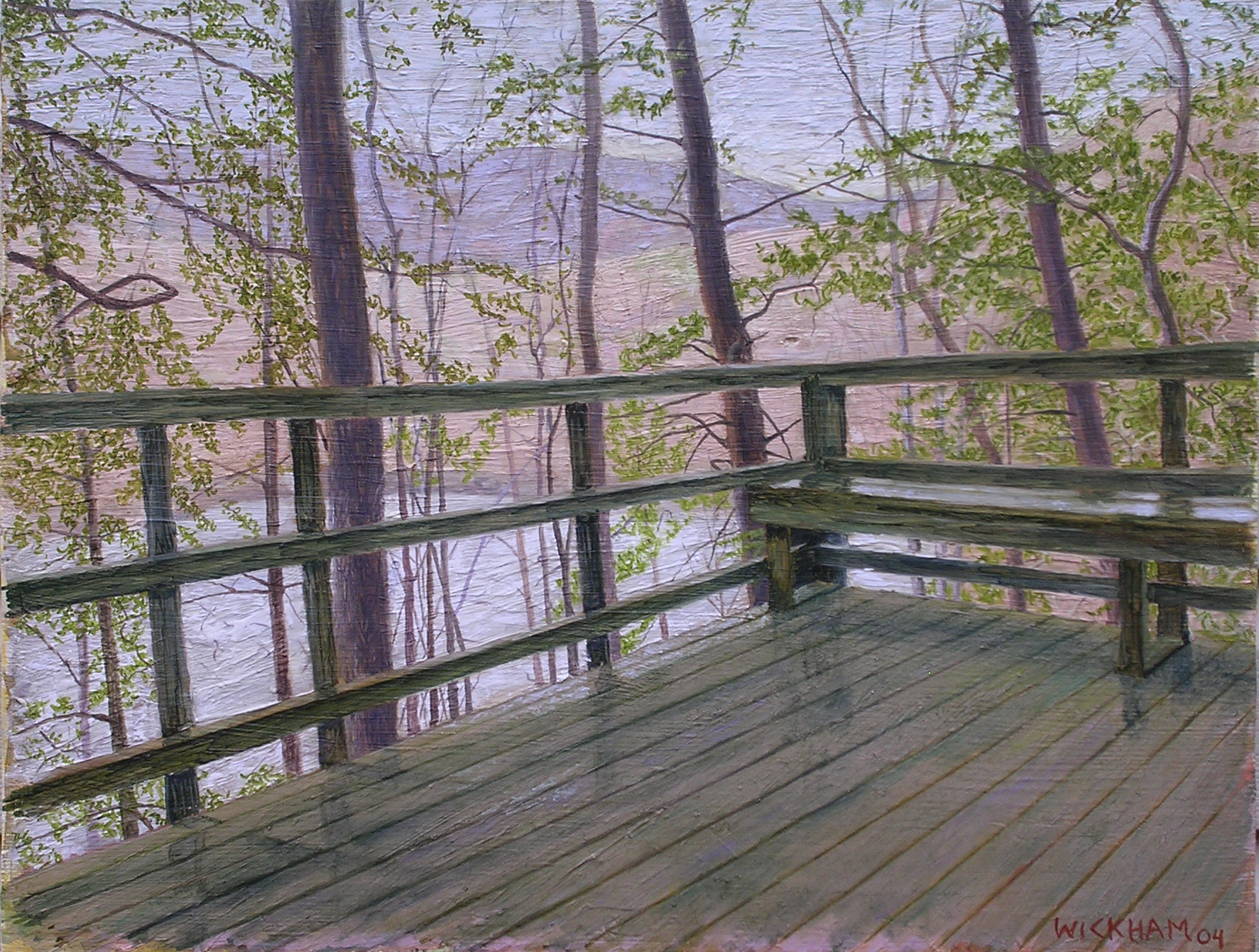

Gerard Wickham, Furnace Pond, Tymor Park, Oil on Wood Panel, 2004, 17.25" X 22.5"

In 2018, the first year of my retirement, I decided that once the weather was reasonably mild I would get outdoors regularly to record some of the local scenery. Most of these works were not very accomplished, but I was happy with a few of them. Tymor in Autumn, a detailed portrayal in gouache of an old clapboard house on the outskirts of the park, was one of the last landscapes that I produced that year and is, in all likelihood, my most successful effort. 

Gerard Wickham, Tymor in Autumn, Gouache on Paper, 2018, 14" X 9"

With the COVID pandemic raging in 2020, I believed it would be irresponsible to organize a multi-figure modeling shoot in preparation for a major work and instead began to entertain thoughts of executing a large landscape painting. In the autumn of that year, many months after the initial outbreak, I was hiking alone in the backwoods of Tymor when inspiration struck. During that first year, I probably did more hiking than I had ever done before in my entire life. On that particular afternoon, I chose a trail that would take me directly to the top of a long ridge of hills. This route ran parallel to a small stream confined within a rocky chasm situated between two wooded slopes. As I achieved the summit, the trail abandoned the stream and headed straight into the woods. A few minutes later, I looked off to my left and saw a scene that probably wouldn't excite the interest of most hikers but really grabbed me. It was late November and the trees were already bare, their discarded leaves several inches deep on the forest floor. Beyond the trees was, inexplicably, an open field, still green with life, and behind that field was a thick screen of violet-gray trees, barely permeated by sunlight. At that time of year, the days are really short, and the sunlight seemed weak and impotent to me. Even though I had gotten out pretty early that afternoon, already the day was waning, the low sun casting lengthy shadows across the fallen leaves. The scene was so melancholy, so emblematic of the end of the bountiful growing season and so filled with foreboding of the bleak winter to come that I stopped in my tracks momentarily steeped in sorrow. Everything about me at that moment seemed absolutely tenuous, vulnerable and transitory. I know this sounds ridiculously melodramatic, but I thought about the changing of the seasons, how the cycle of the seasons related to the cycle of life, which in turn evoked a cognizance of the inevitability of physical decline and ultimately death. The scene before me palpably elicited such thinking. Luckily I had taken my camera with me that afternoon, so I was able to take a series of shots of the scene. It actually took me several days to grasp that this scene would be the subject of my next major work.


After preparing my canvas, I set to work with some loose concepts in mind. Initially, I felt that I might approach this landscape in a Cรฉzannesque fashion, not apishly imitative but vaguely accepting of a fragmentation of form – an effect suggested by the weak autumnal light filtered through a prism of bare tree limbs. I actually devoted several sessions to this approach before recognizing that it wasn't legitimate for me, that I was adopting an artificial vocabulary not true to me. I briefly considered employing a very heightened palette of impasto brushwork, something akin to the technique employed within the compositions of Wolf Kahn, but again this approach was rejected as “dishonest”. At that point, I decided to let my image evolve organically. Though light was very critical to this work, I didn't want the painting to become too atmospheric; my trees had to be solid, weighty forms which spanned the gulf between foreground and sky. I felt strongly that I didn't want this painting to become “fussy”, a direction my natural tendencies veer toward, so I forced myself consistently to use brushes coarser and larger than would seem appropriate to my immediate needs. I wanted my paint handling to be crude and essential. I wanted to minimize technical affect. I was seeking candor.


It took me a full year to complete this landscape. To be honest, I must confess that I wasn't working too diligently and consistently on it. Perhaps experiencing the pandemic stripped me of some focus. For a good chunk of the first phase of the COVID-19 lockdown, our home was filled to the rafters with a crowd of idle workers, a student on hiatus from studying and retired me, and all that inactivity led to some excessive partying. However, if I truly make an unbiased evaluation of my behavior at that time, I would conclude that I was simply not motivated. This landscape provided a distraction for me. When I opted to go up to my studio, I really enjoyed the effort of painting, was satisfied with the approach I had chosen and relished the level of concentration I achieved. But then days would pass without my crossing the threshold of my studio. I have no regrets. It was just what had to be.


When I finished this painting late in 2021, I left it sitting on my easel for weeks and would occasionally visit it to consider the result of my endeavors. Let me make clear that this landscape was not intended to be an austere momento mori. Of course, as stated earlier, I wanted to capture a specific light and a specific mood that late autumn asserts, but, for all its focus on endings, the painting is pretty colorful and vibrant. I particularly enjoy the proximity of zones of orange, green and purple, an aberrant combination for me. Regardless of my response to its coloration, this painting disconcerted me. It is not edgy or outrageous or provocative; it is purposeful and raw and unsophisticated; and I wondered if viewing it offered any recompense... if aesthetically it could please or excite or offend... if it communicated any of the emotional content which I intended. For quite a while I was undecided. It wasn't until I hung the painting on a wall which I pass multiple times on a daily basis that I was able to reconcile myself with this work. I'm satisfied with it.


Gerard Wickham, Deep Woods, Tymor, Oil on Canvas, 2021, 34" X 44"

As I am finishing up this blog entry, it now occurs to me that I may have done a horrible thing. I've let the proverbial cat out of the bag. In singing the praises of this secluded, little-known spot, I could be compromising the very attributes that please me most about Tymor: its serenity, tranquility and lack of crowds. I can envision vying for a parking space in the unpaved lot, waiting in a long line at Furnace Pond's waterfall to catch a glimpse of its sonorous effluence and being accosted by hordes of fellow hikers on remote trails in Tymor's forests. It's a pretty grim prospect. Then I recall that my blog enjoys only a very minuscule following making my fears completely unfounded. I can let out a sigh of relief. And to that small assortment of crackpots and eccentrics who actually read my blog, I hereby announce that I gladly invite you to come and experience this wonderful location. Perhaps I just might run into you on the dirt paths tracing the hilltops above the park. We could share a granola bar, hike a few miles together and enjoy a long talk about art.


As always, I encourage readers to comment here. If you would prefer to comment privately, you can email me at gerardwickham@gmail.com.


Saturday, December 11, 2021

Entry - 12.11.21


Philip Guston - The Studio - 1969

I was leafing through the December 2020 issue of ARTFORUM when I came across an article by Steve Locke which addressed the art of Philip Guston.  In this article, Locke describes an experience he had while enrolled in an MFA program back in 1999. During one of his classes, the instructor was showing slides of a variety of images from art history and was briefly discussing them. When he displayed Philip Guston's The Studio, which presents an artist dressed in Klan-like robes painting a self portrait, Locke, the only African-American in the class, was shocked.


I hear my teacher say, "Philip Guston, 1969, The Studio, about six by six feet, oil on canvas."

"Why are you showing us this?" I ask. Everyone looks at me.

"This painting is the beginning of Guston's departure from abstraction and return to a new kind of figuration."

"And was he in the Klan?" I ask.

"No," my professor says. "Although he uses this figure as an alter ego."

"He's white?"

"Yes. And Jewish. There was a lot of controversy about Guston. You should examine it. Next slide."

I scribble down the name. An alter ego? A Jewish artist painting himself as a Klansman? I am not able to pay attention to the other artists in the slide presentation. The Guston picture is all I can think about. I feel certain that my classmates can smell my anger.

-Steve Locke, "Guston, Whiteness and the Unfinished Business of the Vile World", ARTFORUM December 2020


After that class, Locke investigated Guston's oeuvre and personal history and concluded that Guston's painting wasn't an attempt to promote the Ku Klux Klan but to recognize within himself the vestiges of racism. Locke believes that Guston actually confronted his own “whiteness” and the inherent complicity to which silence regarding race issues naturally attests. By the end of the article, Locke determines that in incorporating Klan imagery in his painting Guston wished to expose the undercurrents of racism, hidden and preferred to be ignored by many in America, that continues to assert a powerful and degenerative influence on our society and concludes that Guston had taken the first steps toward “accountability”.


I found several aspects of Locke's article admirable. The courage he exhibits in challenging his professor before his (I assume) all-white classmates is laudable. I honestly doubt that I would have had the grit to do that. And when disturbed by Guston's image, he does something which is seldom done in our modern era: he performs research to learn more about the artist's intentions. Ultimately, he arrives at a conclusion that is in direct opposition to his initial impression. To me, that is evident of an objectivity and intellectual curiosity that is truly rare.


But the article also raised some disturbing questions for me. Shouldn't an artwork be able to function independently as an expression of the artist's intent without the intrusion of supporting documentation, personal history and critical assessment? If The Studio was parachuted into a community of isolated folk with no knowledge of art history or America's checkered past, would the Klansman persona portrayed in the work be viewed as appealing? Could the painting be conceived as a recruitment advertisement for the Klan?


Apparently, a lot of people would have trouble answering these questions.


In 2020, a retrospective exhibit of Guston's work including 125 paintings and 70 drawings was scheduled to open at the National Gallery of Art, after which the exhibit would move on to the Museum of Fine Arts, Houston, the Tate Museum in London and the Museum of Fine Arts, Boston. However, due to the COVID pandemic, the opening was delayed until 2021. Then, in September 2020, all four museums announced in a joint statement that the exhibit would not happen until 2024, that they were”postponing the exhibition until a time at which we think the powerful message of social and racial justice that is at the center of Philip Guston's work can be more clearly interpreted”. Obviously, after the May 25th murder of George Floyd and a summer of heated protests (which unfortunately included incidents of arson, rioting and looting), these four museums were apprehensive about the reception that an exhibition that included Guston's Klan imagery might receive. Would museum goers understand Guston's message? Maybe not. Could the exhibit itself spark rioting? That seems a reasonable prospect. Is it possible that Guston's Klan paintings could be damaged or destroyed in response to their public display? It certainly seemed plausible at that time.


So... Was the postponement of the exhibition an act of cowardly submission or the judicious acknowledgment of a risk that the museums could not justify taking? I believe a look at Guston's oeuvre and an exploration of contemporary censorship might offer some insight.


I studied art many years before Steve Locke did and cannot recall any instructor either in my undergrad or grad school classes addressing Guston's work. There are probably several reasons for this. Guston was a “first generation” member of the Abstract Expressionism movement in New York City. His paintings, at that time, usually consisted of a clot of colors applied in impasto brushstrokes positioned at the center of a canvas. These paintings are difficult and display none of the energy and virtuosity embodied in the work of, let's say, Pollock or de Kooning. In these paintings, Guston was deliberately restricting his artistic vocabulary, forcing his audience to assess paint itself and reexamine what can be construed as “beautiful”. There is a misleading sameness to them which makes it hard to discuss specific works or distinguish an arc of development. Dissecting compositional elements, technical methodologies or historic influences becomes nearly impossible.


Philip Guston - Zone - 1953

Philip Guston - For M - 1955

Philip Guston - Prague - 1956

I didn't know of these works until years after I had become familiar with Guston's later figurative paintings. His abstract work didn't interest me. It was too limited and homogeneous, and I dismissed it. Only recently have I been able to look at these paintings and appreciate, to some degree, their beauty and lyricism.


His later representational work, though initially reviled for being reactionary, was more interesting to me. But, I want to be clear, reverting back to representational imagery at that time (the late 60's) wasn't really that radical. Almost two decades earlier, de Kooning had shocked his fellow Abstract Expressionists by reintroducing the figure in his work, but de Kooning, as did Richard Diebenkorn and the Bay Area artists, retained his Expressionist “vocabulary” while addressing representational imagery. Guston's break with Abstract Expressionism was more extreme.


Guston's representational paintings discarded the technical process and objectives of his earlier work. While the abstract work was lyrical and romantic, the new work was brutal, clumsy and blunt. The colors were dirty, commonly infused with grays, and his palette was extremely limited. Guston adopted cartoon imagery, not the slick commercial replications of the Pop Art artists but an invented catalog of recurring, personal symbols that hearkened back to the crude comic strips of the early twentieth century. The representational paintings are neither pretty nor easily accessible. They offend the viewer's aesthetic acumen. They defy his or her expectation of “craft”.


Philip Guston - Paintbrushes - 1978

Philip Guston - Pittore - 1973

Philip Guston - Studio Landscape - 1975

Philip Guston - The Ladder - 1978

Philip Guston - Head and Bottle - 1975

Philip Guston - Painting, Smoking, Eating - 1972

Convinced that all that I wrote above about this work is true, I must also state that these paintings provide a visual response that is truly seductive. After years of creating and looking at art, Guston has grasped the visual fundamentals and rewards that entice the viewer into looking at an image and has reduced them to a coarse, cartoony concentrate. His images play with perspective in a Cezanne-like fashion both exaggerating and defying its impact on figures and objects. Paintbrushes, shoes, pastries and various other items are artlessly and excessively stacked and overlap one another. The folds, wrinkles and stitching in cloth are overstated; the brads and sutures on the soles of shoes are too evident. Objects extend above the horizon-line or peek over it. Shadows are emphasized, often painted in flat blacks or bright reds. Paint is applied thickly, clumsily, almost haphazardly with very limited modulation of tonality, but there is a real sensitivity and balance to the brushwork all the same. These paintings enhance the pleasure the viewer experiences through visual perception, which is essentially the manner by which the eye deciphers form.


I would say that the vast majority of these paintings are self-portraits documenting the artist's physical decline and his neglected personal appearance. Guston reveals a solitary existence of limited possibilities and pleasures. He indulges in a smoke, a drink, sweets... his bed offering the sole refuge from the demands of the studio. These works are intended to be funny. They offer a playfully exaggerated commentary on the twilight years of a respected artist. I'm not sure if I Ioved these images the first time I saw them, but I do know that I quickly came to enjoy and admire them and believe them to represent an important contribution to the post-abstract idiom.


Early on in his foray into representational imagery, Guston introduced Klansmen characters into his paintings. I had trouble accepting these works. I found the inclusion of Klansmen to be a reference too specific for the type of painting Guston was producing at that time, an approach that addressed a very pared-down reality consisting of a small handful of mundane, emblematic personae and objects and employed an extremely painterly, aesthetically-weighted technical means. Inserting Klan imagery edged Guston's paintings toward the pedantic... the morally edifying. Such imagery contradicted the universality of his other representational work and instead chronicled a paradigm evocative of a specific place, time and social movement. The Klan paintings seemed at odds with Guston's other work and could be conceived to be at cross-purposes with his technical aims. Apparently, while living through the late 60's/early 70's, a time of great upheaval and radical social change in America, Guston felt compelled to participate in the contemporary discourse. Making images heavily invested in a purely aesthetic approach would not be sufficient to assuage his desire to assert his own perspective of current developments and to convey his personal experience of American hypocrisy. When I first saw these works, I was dissatisfied with them; I feel the same today.


Philip Guston - Alone - 1969


Philip Guston - Untitled, Hooded Figures Driving

Philip Guston - Open Window II - 1969

Philip Guston - Scared Stiff - 1970

Philip Guston - City Limits - 1969

But my unhappiness with the Klansmen paintings was about objectives and aesthetics. I was never confused about Guston's attitude toward the hooded figures depicted in his art. The Klansmen are not appealing or admirable. Their robes are stitched together from rags and are often splattered with red splotches (what I assume to be blood). Commonly, the hands of these Klansman are colored a deep red, suggesting their culpability in the murder of numerous victims. The square of stitching at the back of each hood proposes that the wearer may have undergone some kind of hemispherectomy or lobotomy leaving him or her too impaired to evaluate reality rationally. In many works, the Klansmen are crowded compactly into very small cars, triggering associations with the Keystone Kops. Comically, these Klansmen invariably possess cigarettes, somehow finding access to their mouths through their cloth headgear. Guston is ridiculing his Klansmen. They are buffoons.


Some people might argue that, regardless of Guston's intent, simply presenting images of Klansmen in his work is offensive and shouldn't be tolerated, but I would counter that intent should not only be considered but must be of primary importance when evaluating the integrity and worth of art.


Quite a few years ago, I had my own personal episode during which I had to make a judgment call on whether intent is more important than ostensible appearance.


Back then, when our family was still quite young, I always read bedtime stories to the kids... as I would assume most parents continue to do even in this twenty first century. As our children grew older, I did not give up this nightly ritual and instead said a sad farewell to Beatrix Potter, Maurice Sendak, Dr. Seuss, Astrid Lindgren and the Brothers Grimm and adopted more advanced material. My reasoning was simple. Our children were free to choose whatever books they wanted to read and, not surprisingly, commonly turned to easily digestible contemporary literature, showing a clear preference for extensive series that presented a recurring cast of characters and repetitive themes. We had no problem with this, thinking it wonderful that the kids were enthusiastic readers who rapidly pored over reams of written material each day. During this time, each of our children was also assigned a piece of classic literature to tackle on his own, and, during our nightly communal readings, I would select some pretty heavy tomes, always deliberately aiming to find something challenging... usually slightly above their immediate comprehension level. I wanted to be sure that the kids developed a taste for serious literature and attained an extensive vocabulary that included words not regularly pronounced on TV shows or included in popular literature. So together we read the works of Hawthorne, Kipling, Wharton, Camus, Tolstoy, Alcott, Spyri, Conan Doyle, Stevenson, Barrie, Tolkien, London, Fenimore Cooper and Steinbeck, just to name a few, and we, at least I believe, really enjoyed the experience.


To be frugal, I would order books through a catalog company that offered overstocked and out-of-print material at significantly reduced prices. Often, I was able to purchase exquisitely bound and beautifully illustrated hardcover books for a pittance. The downside was I had to spend quite a while leafing through pages and pages of listings to find anything of worth and of course my selections were limited to whatever happened to be available that month. So while perusing the catalog, whenever I came across a classic piece of literature suitable for the children, it would be added to my order form, and, every couple of months or so, I would receive a large cardboard box full of books afloat in a sea of styrofoam peanuts. And hence, in our evenings, the kids and I would gather in the living room, with me situated under a bright lamp and the boys scattered about helter skelter on floor and furniture, to work our way through the backlog of books I had most recently purchased.


Thus it came about that Mark Twain's The Adventures of Huckleberry Finn was slated to become our next nightly selection. I had read this novel for an American Lit class while an undergraduate in college. I recall that the course's professor had a penchant for Twain, and we read a lot of his writings that semester, including some of his lesser-known later pieces. I was particularly impacted by The Mysterious Stranger, an unfinished novel that presents a very dark, bleak perception of the human condition, as being extremely uncharacteristic within Twain's oeuvre. Huckleberry Finn made much less of an impression on me.


As we started to work our way through Huckleberry Finn, I quickly became aware that this book was very different from The Adventures of Tom Sawyer, a novel we had read at least a year earlier. While Tom Sawyer is a light, humorous tale exploring the whimsical conduct of children, Huckleberry Finn addresses very serious issues. In the later book, Twain exposes the blatant racism that infects antebellum plantation culture, lampooning the supposedly upstanding institutions that white society most esteemed. As was especially appreciated in nineteenth century literary assessment, Twain specializes in accurately capturing the specific dialects, accents and vocabulary of his characters. Huck, the story's narrator, employs a casual Southern child's vernacular, while Jim, an escaped captive, uses the language common to uneducated, enslaved Africans during the 1800's. We see the world through Huck's eyes. He is the innocent struggling to make sense of the flawed civilization in which he exists, while Jim represents the moral and compassionate ideal, the true embodiment of the high and revered virtues that plantation culture claims to embrace.


As we made our way through this novel, I became uneasy. My two oldest sons, just then on the cusp of adolescence, were my audience for this reading. Being homeschooled, they were insulated from the vast majority of the most contentious issues impacting American society at that time. They associated with a fairly diverse group of friends and fellow homeschoolers, and, to the best of my knowledge, their interactions were natural and unsullied by bias. I was fearful that Twain's frank depiction of racial injustice in antebellum America might impact on their relations with other children. I wasn't concerned that my sons would be transformed into racists, but I was troubled at the thought that such reading could introduce into their consciousnesses the concept of “the other”, a recognition that, though we are all human, our perceptions, attitudes, emotions and experiences are uniquely shaped by factors like gender, ethnicity and racial identity. Obviously, this period of utopian innocence could not last forever, but I hoped to extend it for as long as possible. I admit my objectives were a bit naive and idealistic.


Equally disturbing for me was Twain's regular use of the word “nigger” in his book. I understand that the author desired to accurately reflect the repugnant vocabulary of his characters and relished assaulting his white audience with its repeated intonation over and over again. But I'm pretty sure that my children had never heard this word before, and I didn't want it introduced into their lexicons. I seriously considered surreptitiously replacing the word “nigger” with “scoundrel” or “lowlife” or “drudge” whenever it appeared.


I am dead set against censorship. When I was growing up, the issue of censorship was hotly debated. Serious literature that depicted sexual activity openly and honestly had been banned from publication in the USA for many years, and this suppression was being challenged in the courts in the early 60's. Promiscuity, adultery, premarital sex, prostitution and homosexuality were considered topics too risque and noxious to be consumed by the general public. The Hays Code, which strictly prohibited the inclusion of nude scenes in movies, was being violated by a new generation of film directors. Comedians who included four-letter words in their routines were charged with obscenity. Lyrics that referred, even obliquely, to drug culture were often revised for television and radio broadcast. Content that didn't support the Vietnam War was considered unpatriotic and was vulnerable to censorship, and material that threatened organized religion or promoted atheism was prohibited. I recall seeing repeatedly on the TV news, clips from courtrooms across the nation showing decrepit, hoary-headed male judges passing sentence on and bitterly remonstrating many a celebrity culprit for violating the high and mighty moral code of the United States of America. At the time, I thought that these proponents of censorship were simply representative of a bygone generation, too inculcated in a long-ago discarded way of thinking to recognize that our society was progressing toward a more reasonable, mature and equitable approach to self-evaluation. The battle against censorship was fiercely and unremittingly fought. I still believe it was a moral struggle, one that secured a sacred freedom for all Americans.


So when I considered putting aside The Adventures of Huckleberry Finn or making adjustments to its language, I was naturally conflicted. Ultimately, I determined that I would trust Twain, as one more skilled and intelligent than I, to effectively communicate his message, one which deplored bias and condemned those individuals who promoted intolerance and prejudice. I decided that “intent” was more important than “content”, that my children would benefit from and be enlightened by Twain's words.


I've always embraced the conviction (falsely attributed to Voltaire) that “I may disagree with what you say, but I shall defend, to death, your right to say it.” I believe that shallow and insupportable concepts will always be discredited in open debate, that base lies will be exposed should a factual examination of their foundations be performed. I want to hear a multitude of opinions, no matter how outlandish they may sometimes seem, and arrive at my own decision as to what is credible or ridiculous or abhorrent. I unequivocally value intellectual investigation over emotional knee-jerk reaction. And I fervently hope that as a people we can make an effort to appreciate that words and images and deeds are complex things that merit fair evaluation and should not be dismissed upon a cursory perusal.


It's pretty ironic that Philip Guston is being reappraised now as a possible bigot, that his art is considered too controversial to be exhibited not by conservatives and racists but by liberals and progressives. I would hope that Guston could find the humor in this. Philip Guston was born in Canada in 1913 to Jewish parents who had fled pogroms in Russia. His family eventually emigrated to California where they hoped to find greater economic opportunity. In America, they were confronted with a rise in persecution resulting from the growth of the Klan, and it has been suggested that the suicide of his father, when Guston was just ten years old, may be partially attributed to his despair over the intolerance he endured in the US. As he developed into an artist, Guston was influenced by the Social Realists, Regionalists and Mexican muralists. Much of his early representational work promotes progressive social change and expresses a desire for a more equitable and humane culture... some of his imagery directly addressing the scourge of the Klan. An early mural, executed by him and fellow artist, Reuben Kadish, was intended to raise money for the defense of the Scottsboro Boys, nine black teens falsely accused of rape, but that work was defaced by LA police (incidentally never held accountable for their actions). When many years later he returned to representational imagery, he didn't shy away from the themes that obsessed him in his youth; instead he chose to look deep within himself to find the unacknowledged racist that resides in each of us.


It came as a surprise to me when the Guston retrospective was postponed. I never thought that his art could be construed as “racist” and simply assumed that Guston's presentation of Klansmen as comic figures, clumsy, moronic buffoons stumbling along through the shadowy periphery of society, must have offended the new generation of pundits and arbiters who could find nothing vaguely humorous in these individuals. I was wrong. I should have understood that, in a time of extremely high emotions, paintings that present controversial imagery, even the well-intentioned work of an unquestionably progressive artist, would be deemed too incendiary to be exhibited publicly.


As always, I encourage readers to comment here. If you would prefer to comment privately, you can email me at gerardwickham@gmail.com.


Saturday, July 17, 2021

Entry - 7.17.21


As I advised in May's post, this new blog entry consists entirely of a piece of my recent fiction. Though I've produced many short stories since my childhood days, I've very rarely attempted (always unsuccessfully) to get published. Consequently I get very little feedback on my efforts. So if you take the time to read this short piece and are so inclined, a few words of criticism would be appreciated. Be harsh. I'm seeking illumination, not affirmation.

As always, I encourage readers to comment here. If you would prefer to comment privately, you can email me at gerardwickham@gmail.com.


Francis Bacon, Head VI, Oil on Canvas, 1949


Crisis

Click. Click. Click.

Elizabeth was in her mother's kitchen fiddling with the stove she was forbidden to touch. She wasn't certain why she was violating the long-established prohibition, and she felt vaguely confused and uneasy.

Click. Click. Click.

Though the igniter was clicking away, the burner did not light and gas continued to collect at the stove top. She knew she should shut off the valve and wait for the gas to dissipate but was determined to get a flame.

Click. Click. Click. Click.

The clicking seemed to be getting louder and more insistent. This was taking way too long, and far too much gas had flowed into the burner. Now it was inevitable that the flame would ignite in a blinding flash, the kind that singes eyebrows and rattles pots and pans. A substantial explosion seemed a real possibility. She started to panic.

Upon opening her eyes, she was unable to determine her location. She was seated, her back stiff and aching. The glass that surrounded her was glazed with condensation permitting only a dull gray light to permeate the interior. A thick blanket, tucked about her chin, concealed her limbs. A feeling of cold, probably the most extreme she had yet to experience in her lifetime, gripped her body, and a miasma enveloped her mind. Where the hell was she?

Click. Click. Click.

She turned to her left. A key ring grasped tightly in a fist was beating at the window, a muffled voice brayed urgently, and, through the clouded glass, she made out an indistinct face. She lowered the window just a crack.

“Liz! Don't tell me...”

“What?” Elizabeth rubbed her swollen eyes. “No, Ann, I'm just...”

“You can't. This is impossible.”

“Can't what? I'm just taking a break.”

“Bullshit!” Ann objected.

“Really. I had only a few hours between shifts. It wasn't worth the trip home.”

“God. You're living out of your car. This is madness.”

Elizabeth exhaled in surrender. “I considered setting up a tent in our yard, but there's still snow on the ground. This is fine.”

“You'll freeze to death.”

“No. I'm fine. Just gotta get out of there for awhile, or I'll go mad.”

“I understand. Really I do. But... this isn't reasonable.”

“Listen, Ann. This thing is bad... real bad. Did you hear Dr. Zalesny died over the weekend? I can't risk bringing it home to my family.”

Her brow furrowed with concern, Ann studied Elizabeth's weary features. “Okay. You'll be staying with me. Definitely not luxury accommodations, but I live alone and, let's face it, we're both equally at risk.”

“I couldn't ask that of you.”

“You're not. I'm insisting.”


Her face was a map etched with the lines of highways and rivers, entire zones tinted in hues of red and purple. A cluster of acne had blossomed beneath her nose, a flashback to her teen years, and a cold sore crowned her upper lip. There was a sheen to her flesh as if she had applied a coat of petroleum jelly to her face. Despite her improvised band-aid cushion, the bridge of her nose, where the goggles rested, was bruised and conspicuously discolored. She gratefully observed that several hanks of her greasy hair were draped over her features veiling the ugliness somewhat.

The image in the mirror shocked and repulsed her. She froze, gaping into the glass. Though never a knockout, Elizabeth had always looked after herself, hygiene and orderliness being of paramount importance to her. She wanted to look fresh and attractive, not flawless or hot. This stranger in the mirror confronted her, asserting a version of herself that violated the boundaries of her every expectation. She was absolutely disgusted.

At the same time, she felt elated to have the protective gear off, to touch surfaces unfiltered by a layer of latex, to breathe cool, unrecycled air. Though inured somewhat to the discomfit, the stifling warmth and the suffocating mask, she still relished the relief of being free, of experiencing sensations normally.

Exhaustion crept upon her and rapidly suppressed all of the emotions that had swelled within her mind just a few moments ago. Elizabeth knew she ought to prepare some hot, nutritious food. If she wanted to stay healthy and fulfill the absurdly demanding requirements of her job, she had to take care of herself... to eat well... to permit herself to relax... to escape the dark reality of work... to seek the solace of distractions. The image of a plateful of stir-fried vegetables strewn over a hill of brown rice materialized tangibly in her imagination, the aroma of sauteed greens filling her nostrils. Merely the thought of quietly reading a book while curled up on a comfortable chair consoled her. Of course it made sense to satisfy a few basic wants.

But her limbs were leaden, her mind submerged in a sea of fog and from time to time her eyelids closed of their own accord... only for a second or two surely. Her body was stating firmly that it could offer nothing more, that willpower must eventually succumb to physical necessity. “Just for twenty minutes or so,” she thought while unfolding the blanket draped across Ann's sofa back; however she knew that inevitably in just a few hours she would be roused from her sleep by her phone's alarm and begin preparing in the weak, blue light of dawn for another day of work.


“So can I leave now?” he rasped at her.

“Didn't they make it clear to you, Mr. Carbone? You're being admitted.” Elizabeth scanned his chart.

“That's ridiculous. I'm fine.”

Through the scratched plastic of her goggles, she examined her patient: the impeccably cropped salt and pepper hair, the aquiline nose, the freshly shaven jawline and the slim, muscular torso.

“You do know you tested positive? You're actually pretty sick.”

“Nonsense. I've got a stubborn cold.” He gasped then coughed uncontrollably for a while. Clearly choking back the cough, he brushed the tears from his eyes and composed himself. “Went to my doctor to get some pills and the nitwit sent me here. Never should have listened to him.”

“He did the right thing, Mr Carbone. You have all the classic symptoms.”

“Lou.”

“Excuse me?” She looked up from her paperwork.

“It's Lou.” He smiled at her almost devilishly. “You can call me, Lou.”

Good-naturedly, she scoffed at his flirtation. “Right, Mr. Carbone. I'll make a note of that.”

“Okay. I'll tell you what. You can keep me here a day or two, poke and prod me... siphon off my blood, if that's what floats your boat. But then I've got a trip to prepare for.”

“A trip?” Elizabeth was incredulous.

“Been set up for months. Going skiing with my posse next week.”

She referred to his chart again. Her patient was in his early sixties. “Seems a little late in the season for that.”

“It's peak in Utah now. Warm weather, clear skies and perfect snow. And the crowds are gone too. Been doing it every spring for nearly thirty years now.” He added confidentially, “Keep this from my ex, but it's always been the highlight of the year for me. I've already got my plane tickets and hotel reservation, so don't tell me a silly cold is going to put the kibosh on my plans.”

Elizabeth smiled lamely behind her mask. “We'll see what we can do.”


Her husband's image edged out of the frame and was replaced by a blurry, backlit shadow. She stared intently at the screen while the camera struggled to focus, then recognized her daughter's distorted features. She gulped.

“Mommy. Is that you?”

“Of course it's me, darling.”

“What happened to your face?”

“Nothing, dear. Can't you see me?” Elizabeth was confused for a moment, then it dawned upon her. “Oh, Charlie. Mommy's being very careful. I wear all sorts of things to keep me safe... kind of like a knight's suit of armor. It's really very, very good, but it makes my skin a little bit sore. The marks go away very quickly. Please don't worry, honey.”

“So you're not hurt?”

“No, Charlie, I'm fine.”

“Where are you then?”

Elizabeth hesitated a moment. “I'm actually very close to you. Not far at all.”

The child's eyes glistened. “Then why don't you come home?”

Elizabeth fought back the tears. She didn't want her daughter to see her crying. “I can't just yet, darling.”

“Why not? I miss you, Mommy.” One thin, glistening line appeared on her daughter's cheek.

Her husband's stern voice intruded from a distance. “Charlotte, we talked about this. You know your mother's taking care of sick people who need her help. She can't be with us now.”

“But I need her too, Daddy. I need her more than they do.”

Elizabeth felt her daughter's anguish. She heard the panic in the pitch of her words.

Her husband's exasperated sigh rasped through the speakers. “Remember you were going to be strong, Charlotte. You don't want to make your mother sad, do you?” he admonished her from off-camera.

“Charlie!” she exclaimed brightly. “Where's Iris? I need to see her too.”

“Can't,” the child answered.

“And why not?”

Her husband intervened again. “Sorry, Liz. She conked out right after dinner. I tried, but she was exhausted.”

Elizabeth did her best to hide her disappointment. “That's alright. I'll catch her next call.”

“Charlotte. It's time to say goodbye to Mommy,” he instructed her.

“But I just got on,” she sobbed.

“We'll talk again real soon, honey.” She smiled at her daughter.

“Promise?”

“Absolutely.”

“When are you coming home?”

“Soon.”

“You better. 'Cause Mandy never gets my hair right. Not ever.”

She felt the blood rush to her head. “Okay, honey. Now I need to talk to Daddy a second. Could you give us a little private time?” When she was sure her daughter had left the room, she cried out angrily, “Are you kidding me, Bill? Using a babysitter at a time like this?”

He reentered the frame. “Didn't have a choice, Liz. They wanted me in the office a couple days each week, and I got them to agree to one day every week or so.”

“You shouldn't be in the office at all!”

“Not if I want to keep my job. And it's not safe to bring the girls grocery shopping with me. Do you know Iris absolutely refuses to wear a mask? Just pulls it off.”

She couldn't accept this. “No, Bill. You don't realize how serious this is. Lots of people are dying.”

“I watch the news,” he objected.

“No. You don't understand. We're completely overrun. I've never seen anything like this.”

“I really do get it. But the schools are closed. Iris' daycare shut down two weeks ago. I don't have many options.”

“How could you make a decision like this without consulting me? Here I am exiled from my own family and you're bringing outsiders into our home. What's the point?”

“First of all, do you realize that you're impossible to reach? And I'm dealing with a situation here that I never could have imagined. Cut me a little slack. And Amanda isn't a stranger. She's been babysitting for us since Charlotte was just a baby.”

“Nothing against Mandy, but every time you allow a person into our home you're exposing yourself and the kids to everybody that person's been in contact with. Who knows what Mandy's been up to... how careful she's being? I imagine her campus is the perfect breeding ground for the virus.”

“Her college closed weeks ago. All the classes are online now. She was able to get tested and came up negative. And we're it. She doesn't babysit for any other families, and she wears a mask at our home. For Christ's sake! Have a little faith in me.”

She could hear in his tone of voice that he was getting worked up. “Okay, Bill. But please don't let your guard down.”


Lou smiled brightly as she entered the room. “Ah, the most beautiful nurse on the ward is paying me a visit.”

Elizabeth glowered at him in mock irritation. “Flattery won't get you out of here any sooner.”

“Honestly. If only I could turn back the clock...”

She studied his chart. “Hey, Lou. I need to talk with you.”

“Uh oh. Here's where she drops the hammer.”

She smiled sadly at him. “Your oxygenation level continues to drop... even with the nose piece. I think the ski trip won't be happening this year.”

He wheezed, then started coughing a dry, rasping cough. “Yeah. I sorta figured that out on my own.”

“Your lungs aren't able to pull in enough air. And you're still quite feverish.”

“It's one hell of a cold, but, don't you worry, I've gotten over worse.”

“It's pretty serious, Lou. I need you to understand that.”

“When I'm all better, I'm going to take you out for a nice dinner. Some place fancy and real expensive. Just to say thanks.”


A nonstop concert of the convulsive gasping of ventilators, the beeping of heart monitors and the ringing of alarms accompanied all of her activities throughout the workday. This was nothing new for a hospital, but now there were more machines and critical patients than she had ever known before. The noise was deafening. When absolutely overwhelmed, she would retreat to the semi-private room Lou had miraculously secured upon being admitted. He wasn't one of the kind of people with whom she usually associated. Elizabeth came from common, plain-speaking stock, and Lou was a character, the sort of colorful persona she couldn't understand and naturally mistrusted. His exaggerated talk and casual romancing would ordinarily have offended her, but, during those strange days, she craved the human connection that his bold familiarity provided. They had many intimate conversations. One evening, she even slipped into disclosing a litany of flaws she had discovered in her husband once they had married, a betrayal she would normally never have permitted herself. She was a little troubled. She had learned years ago that, while it's a good thing to care about a patient's welfare, it's disastrous to become too intensely attached. That would only lead to depression and burnout.

As she entered the room that afternoon, Elizabeth noticed a distinct change in Lou's appearance. The orbits of his eyes were clearly defined and shadowed with a dark, bruised, greenish discoloration. His features were sagging, his impeccably coiffed hair was now oily and disheveled, and his breathing was extremely labored.

“Hey Lou, are you getting enough air?”

Unaware of her presence, he started. “Oh, Liz. Don't sneak up on me like that.”

“Sorry, Lou. I don't think you're getting enough oxygen. I see you working hard to pull in breaths, but your lungs are so compromised they're unable to take in enough air. I'm becoming very concerned.”

“I'm fine,” he rasped.

“You're not fine, Lou. It's definitely in your lung tissue. Now it's a question of how your immune system is going to respond. I'm worried.”

He croaked out a chuckle. “Lies of the biased media.”

“What are you talking about?” she almost cried.

“Just a bunch of propaganda. I'm not scared.”

“Well, you should be.”

She stormed angrily out of the room.


“That's impossible!” she scolded.

“It's not impossible,” he responded. “It's reality.”

“So you're actually going to get on a plane?”

“I have no choice.”

“Of course, you have a choice. You can quit.”

Bill exhaled audibly. “Come on, Liz. We can't make ends meet on just your salary. You know that.”

“I'd rather we were broke and homeless than you and the kids get this thing. People are dropping like flies, Bill. They're talking about bringing in a refrigerated truck.”

“Let's not get overdramatic here. I'll be taking every precaution.” She pshawed in disgust. “We knew this was going to happen sooner or later. My company can't just leave its clients hanging. Some locations are in the middle of implementation...”

“How long?” she interrupted him.

“Not more than a week.”

“Are you kidding me? What about the girls?”

“I've got that all figured out. Amanda's going to stay here.”

“You can't ask her to do that.”

“I didn't. When I told her about your concerns, she offered. Said she and her parents are at each other's throats and our wi-fi's much better than theirs. Acted like we'd be doing her a favor. Honest!”

“I don't know, Bill. How can this possibly work?”

“The girls are thrilled to be doubling up. Amanda'll take Charlotte's bedroom.”

“I thought we agreed that you were going to stop making decisions solo.”


As she crossed the room's threshold, Elizabeth was hit with a tsunami of sound. The television's volume was turned way up. She glanced at the screen and saw, tucked behind a long, colorful counter, a group of individuals angrily ranting about some apparently pressing topic. Turning to Lou, she observed that his eyes were closed, seemingly in sleep.

“Poor Lou,” she mumbled under her breath. “Not only are you sick but now you have to be assaulted with that nonsense.”

She reached up to turn off the television, and his eyes popped open.

“Leave it on!” he commanded.

“How can you stand that, Lou? It's deafening.”

“Truth,” he wheezed.

She folded her arms and stared sorrowfully at him.

“I'm glad you're awake, Lou. I need to talk with you.”

A faint smile lit up his gaunt features as he struggled to speak. “Shoot, gorgeous.”

“I'm sorry to say your condition is worsening. Your immune system isn't beating this thing, and just working to breathe is exhausting you. You really should be on a ventilator at this point, but we have a problem. Our hospital never anticipated needing so many of these machines, so, for the time being, we're experiencing an extreme shortage. There are simply not enough ventilators to go around, and our administrators have determined to prioritize younger patients over older ones. Considering your excellent physical fitness, I think you would respond well if you just got a little help, but right now that isn't happening. This policy is absolutely ridiculous and I'm going to continue fighting on your behalf, but I believe you have a right to be informed of the situation.”

His face expressed such confusion that she wondered if he had understood a word she had said. He patted her hand reassuringly.

“Of course,” he said with real empathy, “You must take care of the young people first.” He panted momentarily. “And I'm really not that sick. Really.”


The weeks that followed were strange in that time seemed to slow to a crawl and yet passed in a blur of routine. Her work was so demanding that she seldom paused a moment to consider the scope of the catastrophe that was unfolding around her. One completed task offered no comfort but the call to move on to another. Although she attempted to pace herself through her workday, the critical needs of her patients imposed a sense of urgency upon her, culminating in a mad frenzy by her shift's end. Gurneys lined the hallways. Every available square foot was used to board patients. Now she flitted from bed to bed, jotting down information, making quick adjustments to equipment, replacing IVs and ensuring that airways remained clear. For most of her career, the death of a single patient during a shift was a significant occurrence; throughout the current crisis, it was uncommon for an hour to pass without losing at least one charge. People were slipping away all around her without family or friends to comfort them. She tried to fill that void, but the obligations of her work didn't permit her the flexibility to spend much time with individual patients. The situation was intolerable.

Making matters worse, she often volunteered to work extra shifts – not that she wanted the extra pay or believed that even in her extreme exhaustion she had that much to offer, but because she felt like an intruder in Ann's apartment and didn't want to exploit her kindness. Her life had devolved into the nightmare of the unanchored and the dispossessed.

For a period of a few days, Lou's condition appeared to stabilize. Even though he showed no evidence of improvement, Elizabeth was optimistic. Many of her patients had descended to a dire plateau only to rally within a few days and begin the slow climb to recovery. She had seen it happen often.

One morning while changing his IV, Elizabeth noticed Lou studying her activities.

“Good to see you more alert. Did they tell you that your numbers have been stationary for some time now? I think it's a good sign.”

“Of course,” he wheezed. “What I've been telling you all along. I'm doing great.”

She pursed her lips and drew them to the side. “I don't get it, Lou. Why can't you admit that you're terribly ill?”

“Because I'm not a puppet. They can't just pull my strings and make me dance.”

“Who are these people pulling your strings?”

“Reporters... and the eggheads... but mostly the politicians.”

“I admit I don't pay as much attention to current events as I should, but I can't see the connection between politics and your health.”

“It's all a show to make us think the sky is falling. They just want to shake people up... make them believe we're in a crisis, so everyone'll panic and grasp at straws.”

She paused for a moment to consider this. “So you don't believe this is real?”

“Not for a second. And I'm proud to say I never wore a mask... not once.”

A wave of pity flowed over her. “Oh, Lou. How could you?”


After that, Lou's condition deteriorated rapidly. The doctors believed that his immune system had gone into overdrive. Besides attacking healthy lung tissue, it apparently was targeting his kidneys and possibly his liver too. One of the hospital's physicians advised her that, if the heart became infected, the battle would be over very quickly.

One afternoon when she stopped by to visit, Elizabeth found Lou lying on his side, eyes open yet taking nothing in. She deliberately stepped into his line of vision, stooping to bring her face closer to his, but there was no glimmer of recognition. He was clearly exhausted, unable to connect with the surrounding world any longer. Elizabeth could only adjust his nose piece which had been tugged askew and monitor his vitals. She checked his IVs to be sure all was in order. Hesitant to leave his side, she lingered in the room, feeling completely ineffectual. The desire to penetrate his fog, establish a connection and assure him that he wasn't alone engulfed her, nearly crippling her.

For a day or two, he sank deeper into a nearly catatonic state. It became clear that Lou wasn't going to make a miraculous recovery, and Elizabeth tracked his status tirelessly to ensure that she would be at his side when his time came.

One morning while just starting her shift, she was pulled aside by her supervisor.

“He went into arrest twice and was resuscitated each time, late last night and again early this morning,” she informed her.

Elizabeth gasped.

“We won't do it again. It's just cruel at this point.”

Elizabeth started to argue, then reined herself in. She knew that this was the most humane course of action.

Even though she was needed elsewhere, Elizabeth remained in Lou's room throughout the morning. He looked terrible, almost as if he had been beaten. Scattered about the room were the remnants of the staff's earlier efforts to revive him: syringes, tubes of conductive gels, bloodstained bandages, masks, paper gowns and all kinds of packaging. A defibrillator stood by his bedside. His respiration was so shallow that several times she placed a stethoscope on his chest to persuade herself that he was still breathing. His pulse was weak and irregular.

Unwittingly, tears fell from her eyes. She could taste their salt on her lips. Butted by a wave of frustration and despair, she lamented, “I'm so, so sorry, Lou. This virus is a demon.”

She was shocked to see his eyes open momentarily. While focusing on her, he struggled to speak, mouthing his words more than voicing them.

“Just a cold,” he asserted.

Within minutes he was gone.

Something broke inside her. Almost immediately, she was glutted with anger: anger at the physical discomfit she suffered every day... anger at the sacrifices she was forced to make... anger at the risks to her own life she reluctantly accepted as a professional responsibility... anger at being separated from her family... anger at holding steadfast while all those around her tried to undermine her efforts... anger at the multitudes who were choosing to embrace lunacy over reason.

“You fucking ignorant old bastard!” she shrieked.

Appalled by her outburst, Elizabeth froze and looked through the glass partition that separated Lou's room from the central treatment area. She expected to see doctors and orderlies rushing to restrain her, but everyone was oblivious to her transgression - simply going through their customary routines.

Sensing she was losing her balance, she stumbled out of the room and fled down a corridor. Huddling beside a vending machine, she pulled her phone from her pocket and frantically dialed home.

“I really need to talk with you. I think I'm losing it,” she blurted out.

“Excuse me. Bill stepped out for a moment. Can I take a message?”

Her head was swimming. “Mandy?”

“Oh, Mrs. Conway. I'm sorry I didn't recognize your voice. He should be back in...”

Elizabeth ended the call without saying another word, feeling more lost than ever. With no plan in mind, she let her feet carry her toward the glaring light at the end of the corridor. Under her breath, she muttered phrases like “I've had it!” and “I'm through with this shit!” as she marched down the hallway, passing an administrator, two nurses, an orderly and one elderly janitor mopping up a puddle of brown fluid on the floor. No one seemed to take any notice of her. However one teen-aged candy striper stared wide-eyed as she crossed her path, grumbling, “This is just bullshit!”. Elizabeth pushed open the red handled emergency door, setting off a loud alarm, and exited into the cool sunshine.


The landscape flowed by her in a blur as she drove home. She wasn't sure what she would do once she arrived, but she knew she had to reclaim her life. She was through with the hospital. It was an insane place filled with insane people. It made demands of her that were unreasonable, putting everything that mattered most to her at risk. That was over.

Her heart pounded wildly, and she was panting to catch her breath. She was so lightheaded that she feared she might veer off the road. Elizabeth felt that the world was no longer real, that it was crumbling... dissolving into nothingness. Everything she had faith in... every principle that had steered the course of her life no longer applied.

As the car came to a stop at a traffic light, she peered through the windshield unsure of what she would see. It wouldn't have surprised her to witness a comet plummeting to earth or a host of golden armored angels, some blowing clarions, others clutching upraised swords, surmounting the distant ridgeline. But she was stunned to observe an ordinary late spring day. The sky was cloudless, granting the brilliant sun unchallenged dominion over the landscape. Scattered throughout a field of lush grass, an array of stately oaks, crowned with clusters of bright green leaves, swayed in the gentle breeze. An elderly man carrying a bag of groceries shuffled along the sidewalk. A groundskeeper pushed a spluttering mower back and forth across the lawn. In the park, a mother and her toddler sat upon a blanket in the shade, their laughter invading the car's interior... shredding the conception of reality she had embraced just a moment earlier.

When the light changed, she pulled through the intersection and stopped her car at the curbside. Her hands still grasping the steering wheel, she rested her head on the hot, molded plastic and squeezed her eyes tightly shut. She wept over the grotesque inequity of her situation. Her tears rushed to the bridge of her nose then fell to the floor mat. Her nose began to run, and she sniffled repeatedly. Her head throbbed. For quite some time, she was unable to move, paralyzed by the emotions coursing through her mind. Restraining a powerful desire to let out a wail of frustration, she lifted her head and wiped her eyes and nose on her shirtsleeve.

Then she started her car and made the U-turn that would point her back toward the hospital.


© 2021 by Gerard Wickham